
Are you obliged to participate in FuelEU Maritime? And is the NEa your Administering State? If so, you can use the step-by-step guide below to ensure your fleet meets the new requirements for greenhouse gas (GHG) intensity and onshore power.
Outlined below are the steps you need to take to be compliant. In case you are unsure who the compliance entity is, please read the section 'Who is responsible?'.
Milestones and Compliance Tasks
If the NEa is your Administering State, please find below an overview of your compliance tasks and helpful links.
Monitoring
The table below summarises the timeline of the different milestones and compliance tasks in the monitoring period, as well as of the different documents that need to be delivered and obtained.
THETIS-MRV is the central platform used to submit and verify monitoring plans and fuel energy reports. For FuelEU, a dedicated module is used. It is vital to ensure your company information and contact details are up to date in THETIS-MRV, as this system links your MRV, ETS, and FuelEU data.
You must have submitted a monitoring plan to your verifier for each ship.
- The plan must outline the methods for monitoring and reporting the amount and type of energy used on board
- It must include data on the GHG intensity of fuels (Well-to-Wake)
- Use the template provided in the FuelEU implementing regulations within THETIS-MRV
Your verifier assesses the monitoring plan and validates your annual FuelEU reports.
- You may use the same verifier for both ETS/MRV and FuelEU, provided they are accredited for both regulations
- For the Netherlands, you can check accredited bodies via the Dutch Accreditation Council (Raad voor Accreditatie) or other EU countries’ accreditation bodies
Where the verifier’s assessment identifies non-conformities with the requirements of the Regulation, the company concerned must without undue delay revise its monitoring plan accordingly and submit the revised plan for a final assessment by the verifier before the reporting period starts. (Article 11 (1)).
Begin monitoring the energy consumption and GHG intensity for all ships in scope. This includes:
- All energy used at berth in EEA ports
- 100% of energy used on voyages between EEA ports
- 50% of energy used on voyages to/from non-EEA ports
Check at least annually whether the monitoring plan still reflects the ship’s operations. Updates are required if there are changes in fuel types, emission factors, or measurement equipment.
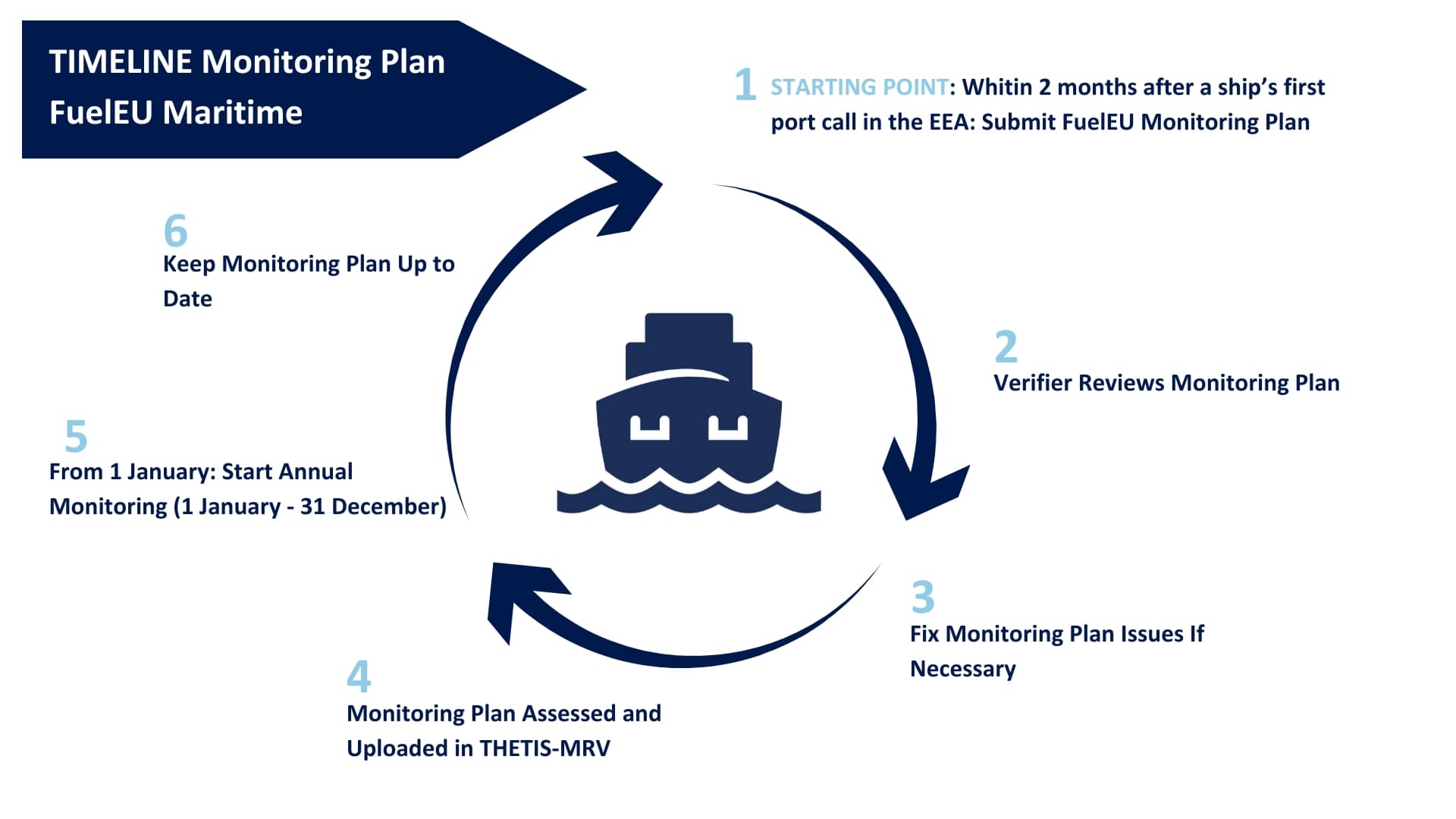
Image: © NEa
Reporting and verification
The table below summarises the timeline of the different milestones and compliance tasks in the reporting and verification period, as well as of the different documents that need to be delivered and obtained.
For each ship, you must submit a FuelEU Report to your verifier. This report contains the total energy consumption and the calculated average GHG intensity for the previous year.
The verifier must conclude the verification of your ship-specific FuelEU reports. Once verified, the data is recorded in the FuelEU compliance database (THETIS).
If a ship has a compliance surplus (intensity lower than the limit) or a deficit (intensity higher than the limit), you can:
- Bank the surplus for the next year
- Borrow from the following year's limit (within certain bounds)
- Pool the compliance balance with other ships (even those managed by different companies)
If a ship still has a compliance deficit after using flexibility mechanisms, you must pay a FuelEU penalty. This payment is made to the Administering State (NEa for the Netherlands).
Once compliance is confirmed (either through meeting the targets, pooling, or paying the penalty), the verifier or the Administering State issues a FuelEU Document of Compliance.
Important: Ships must carry a valid DoC on board to enter EEA ports. Failure to produce this during an inspection can lead to detention.
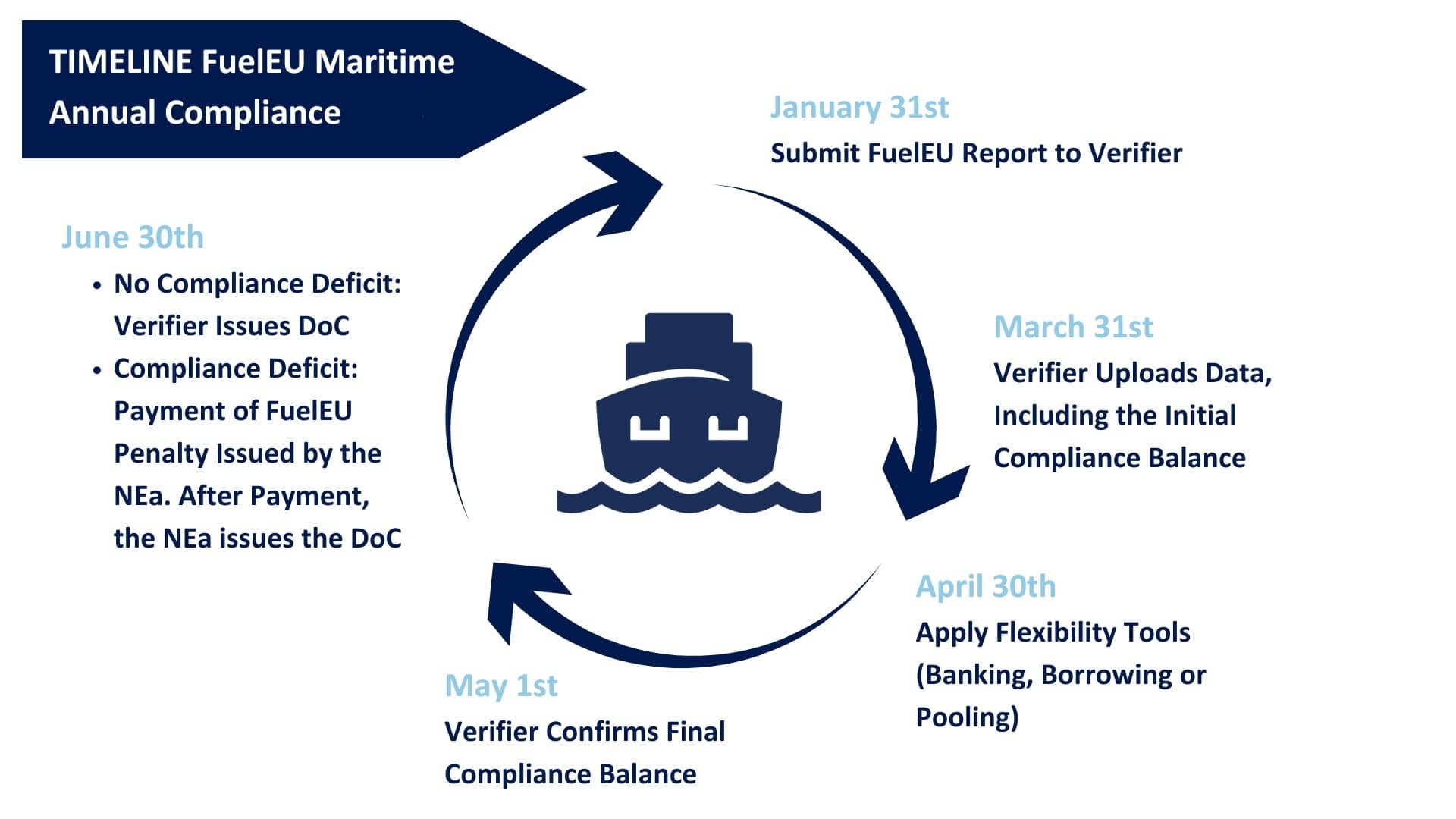
Image: © NEa
Do you have any questions?
If you are unable to find the information you are looking for on our website, you can contact the Helpdesk NEa.
- Telephone: +31 (0)70 456 80 50 (Mon–Fri, 09:00–12:00 and 15:00–17:00)
- E-mail: please use the contact form on our website